

How to Optimize Your Woocommerce Product Name for Voice Search
Introduction
Voice search is no longer the future, it’s now. A report by Seven Atoms found that approximately 20.5% of people worldwide use voice search, supported by an estimated 8.4 billion voice assistants . The study further indicates that around 153.5 million people rely on voice assistants .
In addition, among voice-enabled activities, retail and product search play a key role: 54% of U.S. users use voice for retail purposes, and 40% of consumers use voice to research products.
Given this dominance, your product’s name needs to be not just visible, but also voice-friendly. This article guides you through optimizing product names to land top in voice results.
1. Why Voice Search Changes the Game
1.1 Search is Conversational, Not Keyword-Based
Voice queries are naturally longer and more conversational. They often take the form of questions like, “Where can I find the best waterproof Bluetooth speaker under $50?” rather than short keyword strings. According to research, users expect quick, clear answers.
1.2 Featured Snippets and Position-Zero Matter
Featured snippets are crucial for voice search optimization. For instance, over 40% of voice results are pulled from featured snippets. Additionally, 75% of voice answers come from the top three search results . This makes optimizing your product name and supporting content essential for capturing those spots.
1.3 Voice Commerce Is on the Rise
Voice shopping is booming. As earlier indicated, nearly 50% of U.S. consumers have used voice assistants for shopping . The global voice commerce market is projected to reach nearly $82 billion by the end of 2025, with voice-driven sales expected to represent 30% of ecommerce revenue by 2030 .
2. Common Mistakes in Product Naming
2.1 Abbreviations & Brand Jargon
Names like “XBSPK V3” fail when spoken. For instace, voice assistants might stutter or misunderstand.
2.2 Odd Spelling or Non‑Standard Words
Brands such as “KoolKidz” or “PhatBoi” may stand out visually, but voice systems struggle to recognize and pronounce them correctly.
2.3 Too Generic or Ambiguous
Examples like “Smart Box” are forgettable and easily dismissed by voice assistants, which might choose something more descriptive.
2.4 Using Made-up Words Without Context
- For example: Zynqx, Trelxa, Quixloo. These may sound unique but are hard to spell, pronounce, and remember, making them nearly invisible in voice and text search.
- Voice assistants may often misinterpret or ignore them.
2.5 Too Long or Complex
- For example: “The Ultimate High-Fidelity Portable Waterproof Bluetooth Outdoor Travel Speaker Pro Plus”
- Overloading your product name makes it:
- Difficult to remember.
- Hard for voice search to parse.
- Prone to truncation in listings.
2.6 Overuse of Acronyms or Alphanumerics
- For example: XTR-B420X or BB200-KX
- While it may work internally, customers won’t search for or speak acronyms naturally.
- Voice search often can’t recognize letter/number combinations correctly.
2.7 Inconsistent Naming Across Channels
- If your product name appears differently on your website, Amazon, and Google Merchant Center (e.g., “HydroMax Speaker” vs “Hydro Max Waterproof Sound System”), it causes confusion and weakens SEO.
2.8 Failing to Include a Functional Keyword
- For example: Naming a product “Nimbus” instead of “Nimbus Wireless Earbuds”
- Descriptive keywords like speaker, earbuds, backpack, lamp help search engines (and humans) understand what the product is.
2.9 Copying Competitors Too Closely
- For example: Naming your earbuds “AirBuds” to mimic Apple’s “AirPods”
- Risks:
- SEO dilution—you’re competing with a strong brand.
- Voice search confusion due to similarity.
3. Principles for Voice‑Friendly Names
3.1 Keep It Conversational
Test-drive your product name in a voice assistant. Would you naturally ask, “Alexa, find the EchoBoost Bluetooth speaker with deep bass”?
3.2 Make It Easy to Pronounce & Spell
Use common words and phrases. Avoid unusual or foreign spellings.
3.3 Include Descriptive Keywords
Add a short feature descriptor: e.g., “waterproof,” “wireless,” “kids,” or the target environment like “camping.” That way, voice assistants can parse meaning more accurately.
3.4 Be Concise, but Not Too Short
Voice search answers tend to be around 29 words, and voice snippets are designed to be quick. A product name like “AquaShield Waterproof Bluetooth Speaker” — 5 words — is likely ideal.
4. Structuring Your Product Name
| Component | Example Inclusion |
|---|---|
| Brand | AquaShield |
| Product Type | Bluetooth Speaker |
| Primary Feature | Waterproof |
| Use-case Context (optional) | Camping |
Example: “AquaShield Waterproof Bluetooth Speaker for Camping”
This name hits voice search triggers like “best waterproof Bluetooth speaker for camping.”
5. Using Structured Data & Metadata
- Implement Schema.org markup with
name,brand,description, and key product properties . - For ecommerce platforms like WooCommerce, Shopify or Amazon: fill out attributes clearly—“color: blue,” “feature: waterproof.”
- Use Speakable markup (Google) for FAQ-style questions—for example, “What products are waterproof Bluetooth speakers?” .
6. Optimizing Content Around the Name
Alongside your product page, craft content to support voice queries:
6.1 FAQ Sections
Examples:
- “What makes AquaShield waterproof?”
- “Is AquaShield suitable for beach use?”
These help capture context around wear-case questions .
6.2 Conversational Language
Write in everyday tone: “Our speaker includes a rugged design, perfect for outdoor use.” Use numbered lists, bullets, and short paragraphs to improve readability and voice parseability.
6.3 Long‑tail, Question‑based Keywords
Include queries like “best portable Bluetooth speaker for camping” naturally in headers or content .
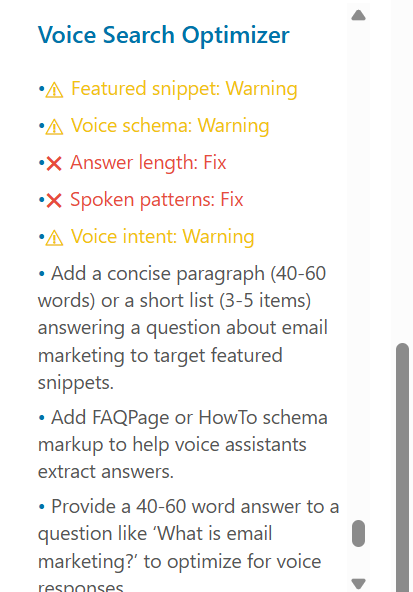
What is the best tool for porduct voice optimization?
If you have your store on Woocommerce, you can use the WordPress plugin, CranSEO.
The tool allows you to modify your products and articles for large language machines (LLMs) including voice search optimization
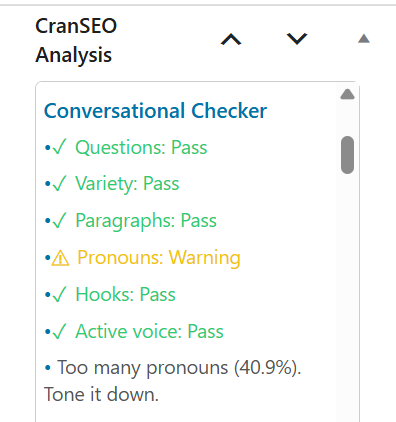
CranSEO enables checks the level of conversation of your content to ensure it is LLM friendly.
Get started with CranSEO for FREE
7. Testing Your Product Name
- Voice Assistant Check
Speak your product name into Siri, Alexa, or Google Assistant. Does it understand it correctly? Does it return your product? - Autocomplete & “People Also Ask”
Search Google for your product name plus “best” or “buy” to view suggested questions. - Featured Snippet Opportunity
Run your top queries like “Is AquaShield waterproof?” Is your answer ready to win that snippet?
8. Product Name Optimizations
Optimized
AquaShield Waterproof Bluetooth Speaker for Camping
- Clear pronunciation
- Features embedded (waterproof, camping)
- Voice-friendly
Not Optimized
AS-WirelessX3000
- Hard to pronounce
- Lacks descriptor
- No context clues
9. Advanced Strategies
9.1 Voice Skills & Actions
Consider building voice apps (Alexa Skill or Google Action) that let users reorder: “Alexa, reorder AquaShield speaker.” This reinforces voice naming.
9.2 Localization & Multilingual Support
Voice search supports over 119 languages. Adjust product naming where needed—e.g., “Parlante Bluetooth Impermeable AquaShield” for Spanish-speaking markets.
9.3 Accessibility Benefits
Voice search supports users with disabilities . Clear naming and natural content help all users, not just search engines.
9.4 Security & Privacy
Ensure that voice-activated features comply with privacy best practices—especially if you build voice skills.
10. Measuring Impact
- Voice Query Rankings: Monitor position in voice assistant search.
- Traffic & Conversions: Track voice-sourced visits and purchases.
- Featured Snippets: Has your product been pulled into voice?
- Voice Skills Metrics: Track usage, engagement, and repeat orders.
Conclusion
Optimizing your product name for voice search isn’t just about SEO, it’s about being found and purchased through voice. With smart naming, natural content, structured markup, and voice‑focused testing, you’re putting your product at the forefront of the voice-first shopping wave. Remember: Users are already talking, make sure your name gets heard.