
15 Proven Ways to Get Your Content Found in ChatGPT, Claude, Perplexity, and Other AI Tools
Introduction
As AI tools like ChatGPT, Claude, and Perplexity become mainstream, more people are turning to them not just for conversation, but for answers, recommendations, and even product discovery. This shift signals the rise of a new kind of SEO: LLM Optimization, which is getting your content seen and referenced by large language models (LLMs).
Unlike traditional search engines, these AI tools don’t serve clickable links on a results page. Instead, they summarize, synthesize, and cite content from across the internet. If your website, blog, or product isn’t visible to them, you risk being invisible to millions of users who rely on AI assistants.
So how do you make sure your content gets found in the age of AI? Below are 15 proven strategies to help your content surface in ChatGPT, Claude, Perplexity, and other LLM-based platforms.
How do LLMs Discover Content?
Before diving into tactics, it’s important to understand how LLMs like ChatGPT and Claude get their knowledge in the first place.
How LLMs Are Trained
Most large language models are trained on massive datasets collected from publicly available content across the internet. This includes:
- Web pages crawled from sites like Wikipedia, news outlets, forums, and blogs
- High-authority platforms like Reddit, Stack Overflow, Quora, Medium, etc.
- Open-access repositories such as Common Crawl
If your content appears in these training datasets, it has a higher chance of being referenced by AI tools, even long after it’s published.
ChatGPT vs Google: What’s Different?
Traditional search engines like Google rank content based on backlinks, keyword optimization, and search intent. In contrast, LLMs prioritize context, clarity, and trustworthiness. They use probabilistic reasoning to determine what information best answers a user’s query, often favoring well-structured and factual content.
This makes language quality, topical relevance, and structure more important than keyword stuffing or backlink chasing.
Why is it important to be found in ChatGPT, Claude, Perplexity and other AI tools?
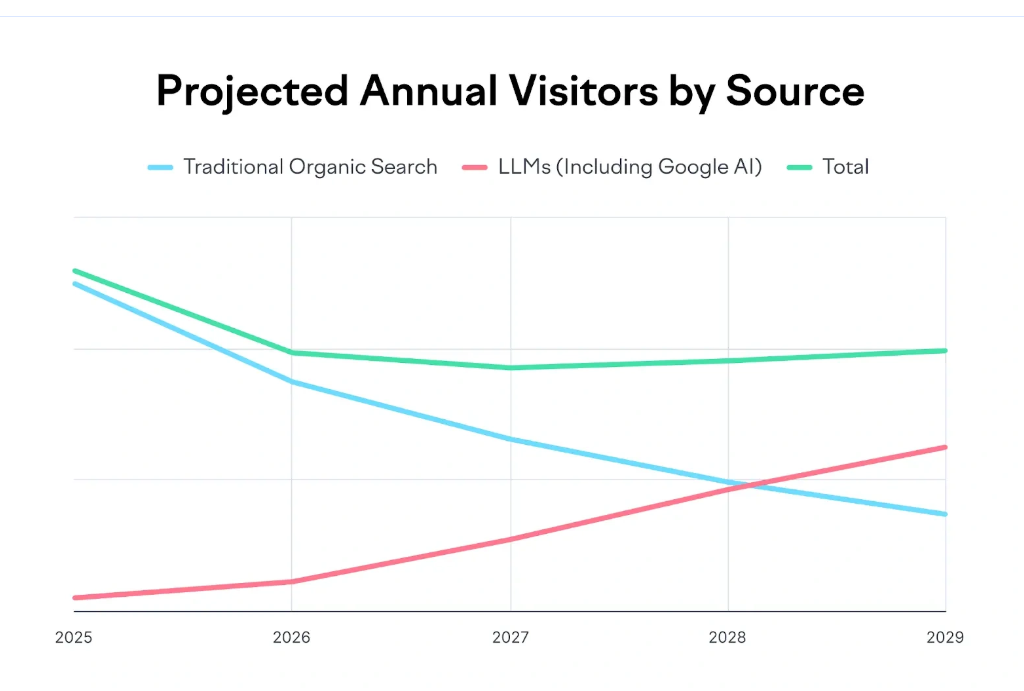
AI adoption continues to grow exponetially. For instance,
ChatGPT is the largest Ai tool in the market accounting for 62.5% of the AI market share as of today. In addition, the platform recieves over 800 million users per week and over 125 million active users per day.
The growth in the use of these tools is only projected to grow in to the future which is why, you should be found where your customers are searching.
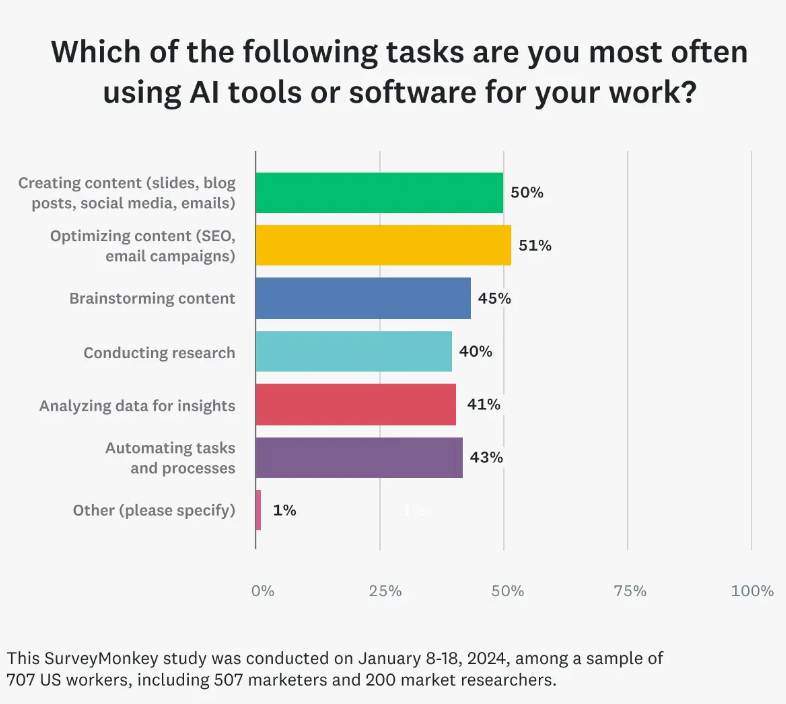
Marketers are also realizing the importance of AI tools in their daily operations. A report published by SurveyMonkey shows that 88% of marketers are using generative AI tools.
Here are the 15 Proven Ways to Get Your Content Found in ChatGPT, Claude, Perplexity, and Other AI Tools
1. Write Clear, Context-Rich Content
LLMs thrive on clarity and context. Unlike Google, which relies heavily on metadata and backlinks, AI tools extract meaning from your actual text. That means your content should:
- Answer real user questions directly.
- Use natural, conversational language.
- Provide relevant background and definitions.
Tip: Use the “explain like I’m five” test. If a smart 10-year-old can understand your post, it’s probably LLM-friendly.
2. Focus on Topical Authority
AI tools favor content from sources that demonstrate depth and consistency on a subject. If your blog has 20 high-quality articles on email marketing, ChatGPT is more likely to see you as a reliable source in that niche.
Tip: Use content clusters, a main topic (pillar page) supported by detailed subtopic articles linked together.
3. Structure Content Logically (Headings, Lists, Tables)
LLMs understand and extract information more easily from well-structured content. Use:
- Descriptive H1–H4 headings
- Bullet points and numbered lists
- Tables for comparison
- Short, digestible paragraphs
This structure makes it easier for LLMs to turn your content into quick answers or featured summaries.
Example: A “Top 10 Benefits of Vitamin C” article with clear bullets and a comparison table is more likely to be summarized by Perplexity or ChatGPT.
4. Use Schema Markup & Structured Data
Schema markup (like FAQPage, Article, Product, and HowTo) helps machines understand your content. While Google uses this for rich results, LLMs also benefit from structured content because it’s easier to parse and index during training.
Tip: Use plugins like CranSEO, Rank Math, or Yoast SEO to automatically add structured data to your WordPress site.
5. Make Your Website Crawlable and Indexable
If LLMs can’t access your content, they won’t use it. Ensure:
- You’re not blocking crawlers like GPTBot, Common Crawl, or Anthropic’s ClaudeBot in your
robots.txtfile. - Pages have no-index or nofollow tags only where necessary.
- There are internal links so bots can navigate your content.
Tip: Test your site with tools like Ahrefs Robots or Screaming Frog SEO Spider to check crawlability.
6. Submit Content to Open Datasets (Like Common Crawl)
Many LLMs, including early versions of ChatGPT and Claude, were trained using Common Crawl, a massive dataset of publicly accessible web pages. While there’s no form to “submit” your site directly, making your content discoverable by their crawlers increases your chances of inclusion.
✅ Tip:
Ensure your site doesn’t block the CCBot (Common Crawl’s user-agent).
Submit your sitemap to platforms like commoncrawl.org.
7. Publish on High-Authority Platforms (LinkedIn, Medium, Substack)
AI models are trained heavily on public, high-trust platforms. Publishing articles or repurposing your content on platforms like:
- Medium
- LinkedIn Articles
- Substack
- Reddit
…gives you a better chance of showing up in LLM-generated responses.
Example: A well-written Substack post on climate change may appear in Perplexity results or even get referenced in Claude’s responses.
8. Get Cited by Authoritative Sources
When reputable websites link to or mention your content, it signals trust and credibility. LLMs are more likely to reference content from sources that are frequently cited or associated with .edu, .gov, or major media domains.
Tip: Pitch your content to journalists via platforms like Help a B2B Writer or build backlinks through guest posting.
9. Optimize for E-E-A-T (Experience, Expertise, Authority, Trust)
AI tools, just like Google, favor content that reflects strong E-E-A-T principles. That means showing:
- Real-world experience with the topic
- Verified expertise
- Recognizable authority (personal branding, citations)
- Trust signals (testimonials, transparency, contact info)
Tip: Add author bios, credentials, and original research to your content pages.
10. Build a Digital Identity and Author Profile
LLMs often mention or trust content associated with recognized names or entities. If your name or brand is mentioned across multiple sites and platforms, your content has a higher chance of being referenced.
✅ Example: “According to Denis Omollo, an expert in supply chain and digital content…” — ChatGPT can generate these references if your name appears consistently online.
✅ Tip: Create and maintain author profiles on:
- Google’s Author Markup
- GitHub (if technical)
- Your own “About” page
11. Answer Questions on Quora, Reddit, and Stack Exchange
AI tools frequently pull data from community-driven Q&A platforms. If you provide thoughtful, in-depth answers on:
- Quora
- Reddit (especially subreddits like r/SEO, r/AskHistorians, etc.)
- Stack Overflow / Stack Exchange
…your responses may be included in AI training data or even cited directly by tools like Perplexity.
Tip: Answer real user questions in your niche, then link to relevant blog content (when appropriate).
12. Repurpose Content into FAQs, Listicles, and How-Tos
LLMs love structured content, and formats like:
- FAQs
- Step-by-step guides
- Listicles (“10 tips for…”)
…tend to get directly quoted or summarized.
Example: Instead of writing a 2,000-word article alone, break it into a “How to do X in 5 Simple Steps” or “Top 7 Tools for Y”—increasing chances of being parsed into answer snippets.
13. Create Long-Form, Evergreen Content
LLMs are trained on substantial, lasting content, not just trending news. Long-form articles that:
- Answer timeless questions
- Provide deep explanations
- Stay relevant year after year
…have a better shot at inclusion in LLM datasets.
Tip: Regularly update cornerstone content to keep it fresh and valuable. Add internal links, new stats, and visual structure.
14. Test Your Content in ChatGPT, Claude, and Perplexity
You don’t have to guess whether your content is being picked up, ask the models directly. Try:
- Asking your target questions in ChatGPT or Claude.
- Seeing which websites or content is being cited (especially in Perplexity).
- Prompting AI with: “List top blogs about [your topic]” or “According to which experts…”
Tip: If your site isn’t showing up, refine the structure, add contextual links, or improve clarity.
15. Monitor and Adapt with AI Mentions and Analytics
As LLM-generated answers continue to evolve, keep tabs on your AI visibility. Use tools like:
- Perplexity.ai (search and see what sources are cited)
- ChatGPT with browsing enabled (to test real-time answers)
- Brand monitoring tools like Mention, BuzzSumo, or Awario to detect AI-sourced traffic and backlinks
Pro Tip: Consider adding an AI-specific UTM tag to links shared on AI-visible platforms to track incoming clicks.
What can you use to make your content found in ChatGPT, Claude, Perplexity and other AI tools?
You can use CranSEO tool to optimize your content for ChatGPT, Claude, Perplexity and the other AI tools.
This is a free WordPress plugin that checks your content for all the parameters we have mentioned in this article. Thisngs like clarity, structure, conversations, tone, links, among others
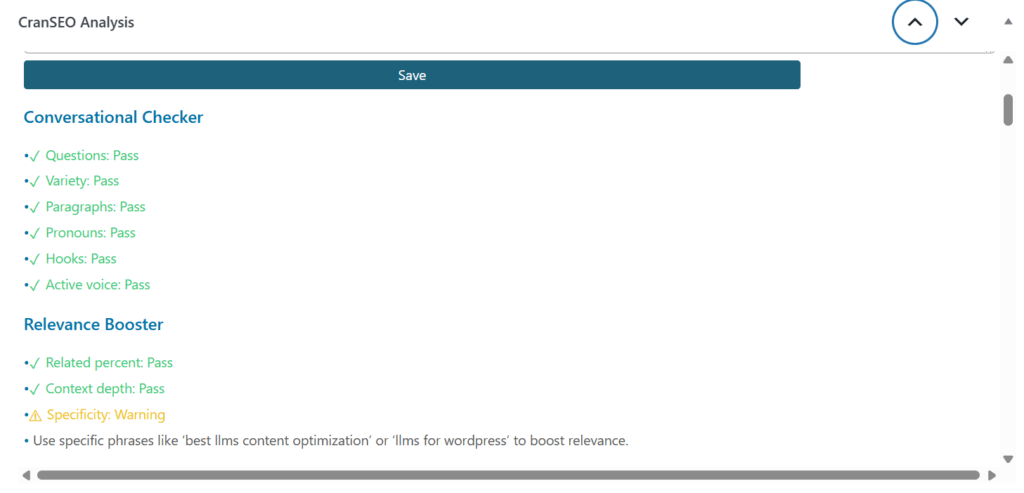
Go to your WordPress Admin dashboard > Plugins > Add plugin > Search for Cranseo
Install > Activate
On the Admin dashboard you will see CranSEO which you can use to optimize your articles.
Conclusion
The future of content visibility isn’t just about ranking #1 on Google, it’s about being found, referenced, and cited by AI.
By writing clear content, improving your structure, building authority, and optimizing for LLM-friendly platforms, you open the door to millions of users relying on AI to make decisions. Start small: update your existing blog posts, republish on trusted networks, and test your content’s AI reach regularly.